Have you ever witnessed the brilliant gold accents in a Jeddah palace shimmer with undiminished light, year after year, defying the corrosive sea air? This is not an accident of maintenance; it is the deliberate result of choosing true artisanship over fleeting imitation. For those who pursue the highest standards of classic interior design, understanding the vast chemical gulf between genuine gold leaf and common metallic paint is paramount. The salty humidity of coastal cities like Lagos and Jeddah relentlessly attacks and degrades inferior finishes. We will explore the science behind why 24k water gilding, a technique perfected by masters like Modenese Interiors, offers a permanent, luminous solution that resists the inevitable tarnishing and peeling of paints. This is the secret to enduring luxury.
The Chemistry of Corrosion: Metallic Paints versus Coastal Air
I believe most people misunderstand what “gold paint” truly is. It is a deception. These paints contain no actual gold. Instead, they are suspensions of fine metallic powders—typically brass, bronze, or aluminum—mixed into a polymer binder. The saline humidity found along the Red Sea coast of Jeddah or the Atlantic shores of Lagos acts as an aggressive electrolyte. This accelerates the oxidation of these base metals, a process detailed in many chemistry resources, such as university-level studies. The result is predictable degradation: a dull, greenish tarnish on brass and bronze, and a chalky white powder on aluminum. The binder itself breaks down under constant UV exposure and moisture, leading to peeling and flaking. This is a chemical certainty.
24 Karat Gold: The Noble Metal’s Ultimate Resistance
Pure, 24k gold is different. It is elemental. As a noble metal, gold possesses a complete outer electron shell, making it exceptionally non-reactive. It does not oxidize. It does not corrode. It does not react with sulfur compounds in the air, which can tarnish silver and other metals. When Modenese Interiors applies genuine 24k gold leaf, they are encasing a surface in a chemically inert, permanent shield. This is not a coating that imitates gold’s color; it is gold. Its atomic stability is why artifacts recovered from ancient shipwrecks, like those found in the Mediterranean, still gleam after centuries underwater. The same principle protects a gilded boiserie in a villa overlooking the Arabian Gulf.
The Art and Science of Water Gilding
The process itself is a testament to the timeless laws of physics and chemistry. Modenese Interiors employs the traditional Italian guazzo gilding method, which is far superior to simple oil gilding for achieving a brilliant, mirror-like finish. This technique is central to achieving perfection in classic interior design.
The Foundation: Gesso and Bolus Clay
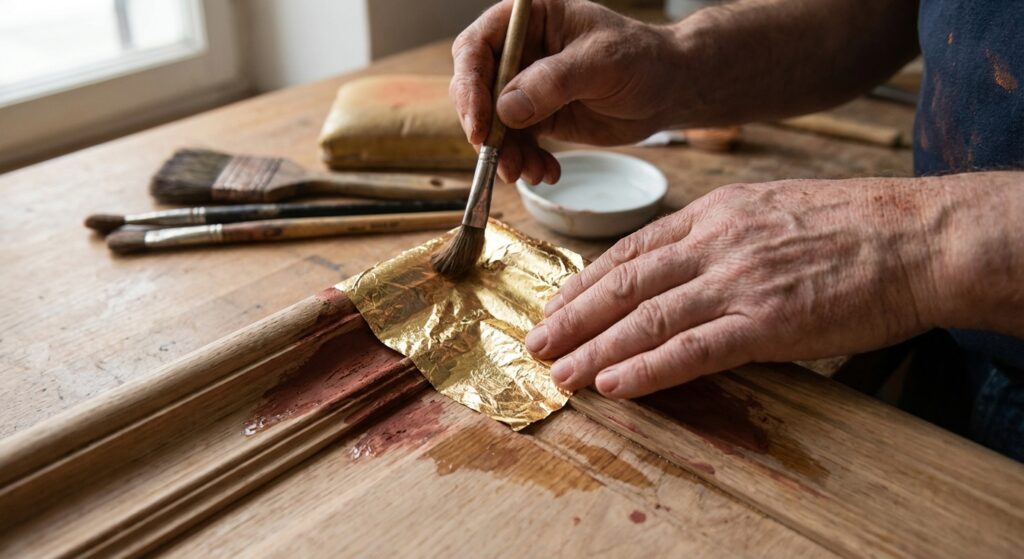
First, the wood surface is meticulously prepared with up to ten thin layers of gesso, a mixture of animal-skin glue and calcium carbonate. This creates a flawless, non-porous foundation. Then, several layers of bolus—a fine, iron-oxide-rich clay mixed with glue—are applied. The Armenian bolus used by master artisans provides a critical, slightly soft cushion for the gold leaf. Its color, typically red or yellow, also lends a subtle, warm undertone to the final gold surface, a detail explained by conservation resources like The Getty Conservation Institute.
The Application and Burnishing
The gilder applies a water-based solution (gilding liquor) to the bolus, which reactivates the glue just enough for the microscopically thin gold leaf to adhere. This is the “water” in water gilding. The magic comes next. Using a polished agate stone, the artisan burnishes the surface. This intense pressure compacts and polishes the gold, creating an absolutely seamless, non-porous, and brilliantly reflective surface. It is a mechanical fusion, far denser and more resilient than any painted or sprayed-on finish could ever be.
A Tale of Two Cities: Investment in Permanence
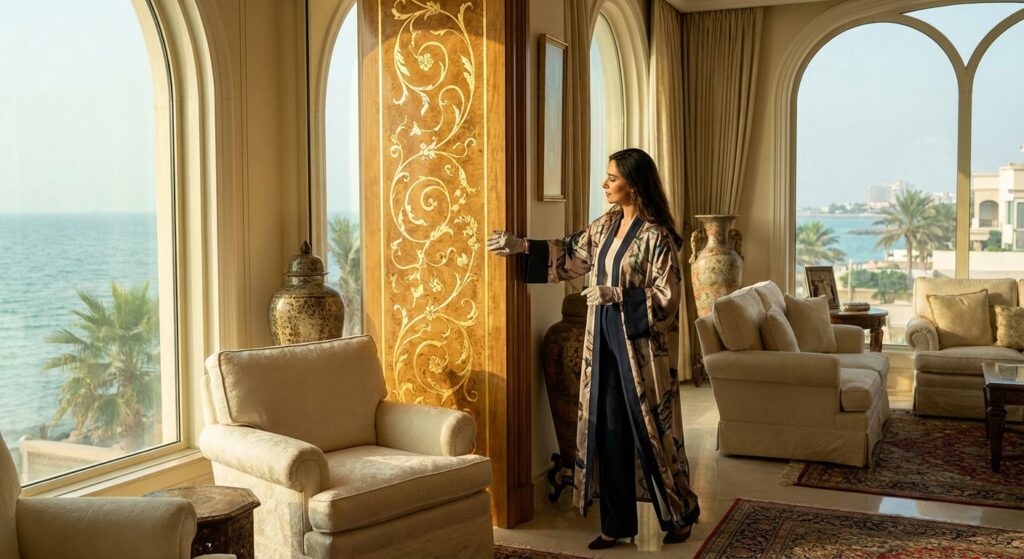
Let’s be honest. The choice between water gilding and metallic paint is a choice between legacy and liability. In a luxury hotel on Victoria Island, Lagos, a “gold” painted accent wall might look acceptable for a year, maybe two. Soon, the relentless humidity will begin its work, requiring costly, disruptive repainting. The initial savings become an ongoing expense. Contrast this with a private residence in Jeddah’s Al-Hamra district featuring boiserie gilded by Modenese Interiors. The 24k gold surface, applied using the water-gilding technique, will look identical in 50 years as it does today. Its luster is permanent. Its chemistry is stable. This is not just decoration; it is a permanent architectural asset, an investment that appreciates and requires minimal care. This approach to classic interior design is about building for generations, not for a single season.
The Unmistakable Aesthetic of True Gold
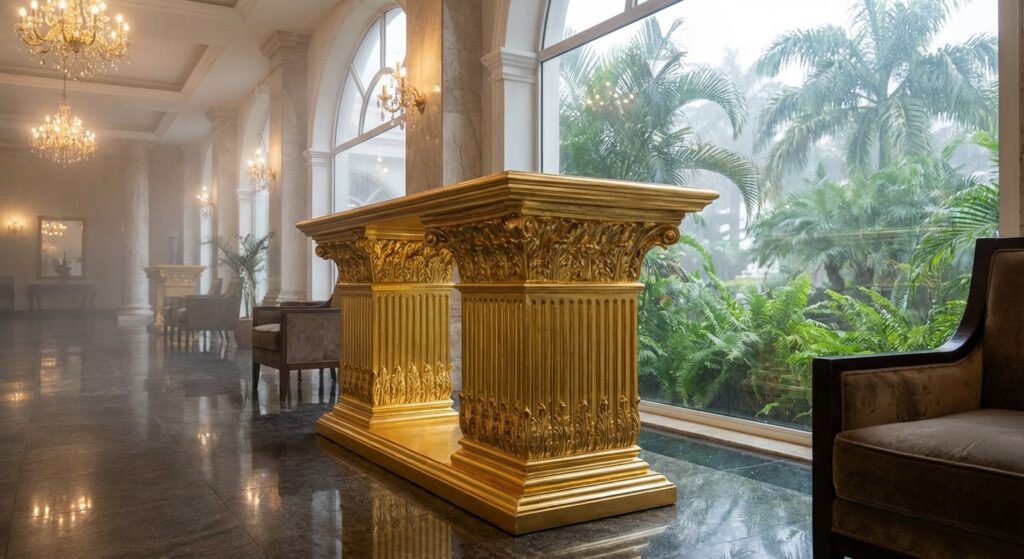
Beyond durability, there is the simple, undeniable beauty. Metallic paint produces a uniform, flat color. It absorbs light. Burnished 24k gold leaf does something entirely different. It has a deep, liquid lustre. It plays with ambient light, creating dynamic reflections that shift throughout the day. The subtle undertone of the red bolus clay gives it a warmth and richness that paint cannot replicate. For any project demanding the absolute pinnacle of excellence, from a royal majlis in Riyadh to a penthouse in Dubai, the visual superiority of water-gilded gold is self-evident. It telegraphs authenticity and uncompromising quality. This level of material integrity defines the very essence of world-class classic interior design.
Frequently Asked Questions
Can lower-karat gold be used for water gilding in humid climates?
While possible, it is not recommended for high-humidity environments. Gold alloys below 22k contain other metals, such as silver and copper, which can oxidize and tarnish over time, especially when exposed to salt and moisture. For absolute permanence in places like Jeddah, 24k or 23.75k gold is the only professional standard for any serious classic interior design project.
How does the bolus clay color affect the final gold finish?
The bolus color provides a subtle undertone that enriches the gold’s appearance. A traditional red bolus, rich in iron oxide, gives the gold a warm, deep glow. A yellow bolus yields a brighter, more brilliant yellow-gold finish. The choice is an artistic one, tailored by Modenese Interiors to the project’s specific aesthetic goals.
Is a water-gilded surface easy to repair?
Yes, for a master artisan. If a gilded surface is scratched or damaged, a skilled gilder can carefully patch the area with new gold leaf and burnish it to blend seamlessly with the original surface. This is a significant advantage over painted finishes, where patching often looks obvious.
What is the primary difference between water gilding and oil gilding?
The main difference is the adhesive and the final finish. Water gilding uses a water-activated animal glue base (bolus) and allows the gold to be burnished to a brilliant, mirror-like shine. Oil gilding uses an oil-based adhesive (a size) that remains slightly tacky. The gold leaf is applied to this size and cannot be burnished, resulting in a more matte, satin finish. Water gilding is the superior choice for classic interior design elements that require maximum brilliance and durability.