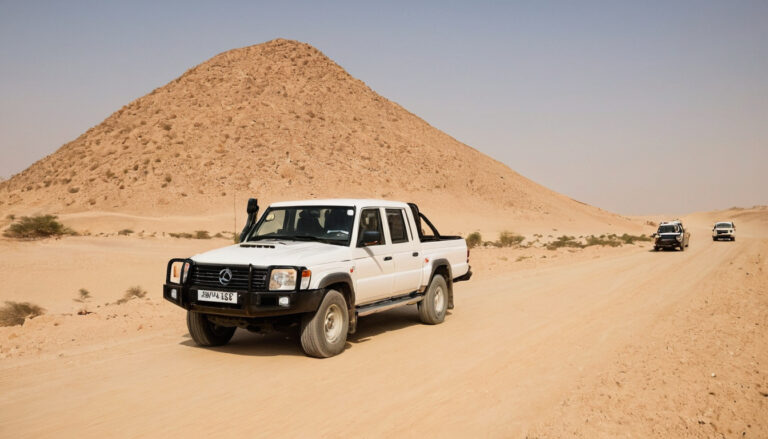
Two quotations may look comparable until one prices a multi-seat buggy per vehicle and the other prices one quad bike per rider. Before choosing the cheaper headline, check exactly what is being allocated, who may drive, how long the party will ride and which liabilities remain with the customer.
Key takeaways
- A buggy seat and a quad-bike rider place are different booking units.
- Compare the named vehicle, usable capacity, route format and actual riding time, not just the product title.
- Separate operator liability, participant injury and vehicle-damage cover before accepting an “insured” label.
- Calculate the payable total, including transfers, mandatory fees and deposits.
- Keep one dated written specification covering the vehicle, route, transfer, eligibility and insurance terms.
Contents
- Choosing between a dune buggy and a quad bike
- Comparing verified vehicle specifications
- Building the complete booking timeline
- Checking licence, age, ID and protective-equipment rules
- Examining insurance and customer liability
- Normalising the total booking cost
- Confirming the product before payment
Which is better in Dubai: a dune buggy or a quad bike?
A dune buggy suits passengers who want side-by-side seating, shared travel and steering-wheel control. A quad bike suits one eligible rider seeking an individual machine. The better choice depends on confirmed capacity, restraints, route supervision, participant mobility and written insurance terms.
A buggy seat and a quad-bike rider place are different booking units
- Solo rider: choose a quad bike for an individual machine, provided the quotation confirms one vehicle per rider rather than a shared riding allocation.
- Couple: compare two quads priced per rider with one two-seat buggy priced per vehicle. Confirm whether both buggy occupants may drive and whether a driver change is permitted during the session.
- Family: request the number of usable seats, passenger eligibility, restraint type and any height, weight or mobility restrictions. A four-seat label does not confirm that every family member qualifies.
- Group: record the vehicle count, seat allocation and rules for empty seats, substitutions and mid-session driver changes.
The right vehicle depends on control, seating, and route supervision
A buggy uses steering-wheel control and carries seated occupants. A quad requires each rider to steer and balance a separate machine. Ask the operator to document the transmission, restraints, briefing, convoy format and guide position for the exact product. First-time riders and guests with restricted mobility should not rely on a generic difficulty label.
Recreational buggy and quad sessions differ from road-legal 4×4 arrangements covered in self-drive and guided desert safety, insurance, and cost differences. After choosing a vehicle type, compare suppliers using the same written specifications.
Dubai buggy and quad-bike products must be compared by verified specifications
Dubai buggy and quad-bike listings become comparable only when each quotation states the same fields: vehicle identity, engine class, booking unit, usable capacity, drive system, restraints, route format, actual riding time and total time at the base. Marketing labels do not establish equivalent products.
Vehicle model and engine class must be documented before comparison
Request the operator’s current fleet information and make a specification ledger for each quotation. A usable record names the manufacturer, model, model year if disclosed, engine displacement or stated power class, transmission, drive configuration and operating base. Mark an absent field as not disclosed. Do not infer a specification from photographs or phrases such as premium and high performance.
- Booking unit: one vehicle, one seat, one rider or one private group.
- Vehicle identity: manufacturer, model and disclosed model year.
- Powertrain: engine class, transmission and drive configuration.
- Operating format: guided convoy, controlled riding area or private guided route.
- Time: advertised session, actual riding time and total time at the base.
- Substitution: the replacement model or minimum specification permitted if the confirmed vehicle is unavailable.
A manufacturer’s specification can describe a named model, but it does not prove that a Dubai operating base will allocate that model. The quotation must identify the bookable vehicle or set a minimum replacement specification.
Passenger capacity requires seats, restraints, and allocation rules
Buggy capacity means usable places under the supplier’s current rules, not just the seats visible in a photograph. Confirm every fitted seat, its belt or other restraint, the roll structure, doors or side nets and any operator-applied speed control. For an ATV quad bike Dubai booking, check whether one advertised unit means one rider and whether passengers are prohibited or permitted under separate conditions.
Allocation rules determine the practical capacity. Ask whether a couple receives a private buggy, whether an unused place can be assigned to another guest and whether a family must split across vehicles. Passenger age, height, weight and mobility conditions must be quoted as supplier policy. Do not apply one operator’s limits to another product.
Does “beach buggy Dubai” describe a desert vehicle or a permitted beach route?
The phrase “beach buggy Dubai” can describe a vehicle style, search label or product name. It does not confirm permission to operate on a beach. Require the supplier to name the operating location, route surface and route authority before presenting a product as coastal riding.
If the supplier names a beach or coastal route, keep the applicable access rule or written permission with the quotation. If that evidence is absent, describe the booking by its confirmed desert base and surface. Once the vehicle and allocation are fixed, calculate the complete time from departure to return.
How long does a Dubai buggy or quad-bike booking actually take?
Time a Dubai off-road booking from hotel departure to return, not solely by its advertised ride duration. Separate the pickup, drive, check-in, briefing, riding, planned stops and return, then date the route-access and seasonal-light information supplied by the operator.
Create one timeline record for every product:
- Transfer: keep the eligible pickup zone, pickup window, desert-base map pin and estimated drive under stated traffic conditions.
- Arrival: record the check-in deadline, registration process and time allowed for changing.
- Preparation: separate the safety briefing, helmet fitting and vehicle familiarisation from the advertised riding period.
- Route: identify actual driving time, guide stops, rest periods and how vehicle recovery affects the session.
- Return: request the base arrival time, transfer departure and expected hotel return window.
A transfer estimate also needs an eligible pickup address. Compare the supplier’s answer with Dubai desert pickup zones and transfer rules, particularly for residences, remote hotels and addresses served through a meeting point.
Guided convoy, open-area riding, and private routes are different products
A guided convoy follows a lead vehicle or guide under stated spacing, overtaking and stopping rules. Open-area riding describes terrain, not unrestricted freedom to choose a route. A private route should identify who shares the departure, where the boundaries lie and whether the guide remains with the party.
Request the guide position, maximum convoy size, marked or fenced boundaries, stop policy and land-access basis. Dubai Municipality identifies Al Marmoom Desert Conservation Reserve as part of Dubai’s protected-area network. That designation does not prove recreational vehicle access or permission for a commercial route. The operator must confirm authority for the named operating area.
Photography time depends on departure, stops, dust, and secure storage
Plan photography around the booking-date departure and return windows, then check the written stop policy. Confirm whether guests may leave vehicles only at designated points and whether a photography stop reduces driving time. Use morning and evening desert timing for heat and photography after fixing the route schedule.
For camera equipment, check locker dimensions, access arrangements and restrictions on loose phones, cameras, mounts and bags. Dust can make lens changes impractical, while unsecured equipment can become hazardous during abrupt movement. With the complete timetable documented, check who may drive or ride.
Do you need a licence, minimum age, or ID to drive a buggy in Dubai?
Minimum-age, driving-licence, identification, passenger and helmet conditions are not universal across Dubai dune buggy and quad-bike products. Confirm the operating jurisdiction, vehicle type and supplier policy, then state whether each rule applies to a driver, quad rider, buggy passenger or supervised minor.
Legal requirements and operator eligibility rules must be labelled separately
A supplier may impose stricter conditions than the relevant law or land-access authority. Ask for the current official rule covering recreational off-road use in the named operating area, followed by the operator’s dated eligibility terms. A marketing-page statement such as “no licence needed” is insufficient unless the supplier confirms the vehicle, route and participant category covered by that statement.
- Driver or quad rider: confirm the minimum age, accepted photo identification and whether an original document or copy is required at check-in.
- Driving licence: obtain a written yes-or-no answer for the booked vehicle. If a licence is required, ask whether residents, tourists and foreign-licence holders face different document conditions.
- Buggy passenger: record the eligibility restrictions, designated seat and restraint, and whether the passenger may change into the driver’s position.
- Minor participant: establish whether written parental consent is sufficient or a parent or legal guardian must attend and remain during the session.
- Supervision: confirm whether the product is instructor-led, convoy-guided or restricted to a controlled riding area.
Helmet and protective-equipment specifications require more than an included-gear label
List protective equipment by item, size and condition rather than describing it simply as included. Request the helmet certification stated by the supplier, available size range, fitting procedure, cleaning process and replacement policy after impact or visible damage.
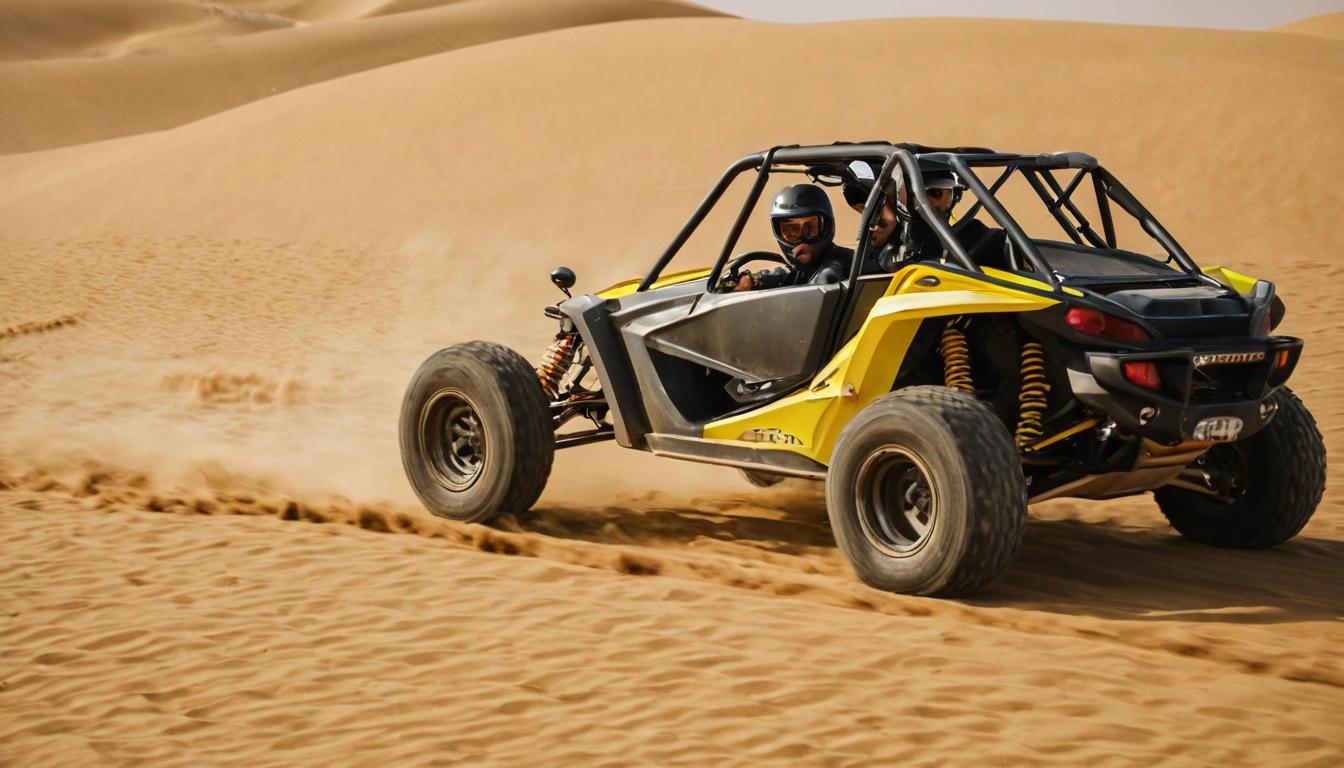
Do you need a licence, minimum age, or ID to drive a buggy in Dubai shown with practical context cues.
- Confirm whether helmets, goggles, gloves and balaclavas are supplied to every driver, rider and passenger.
- Ask whether prescription glasses fit beneath the goggles and whether the supplier gives separate dust guidance to contact-lens wearers.
- Check the required footwear and clothing. Closed shoes and limb-covering garments may be operator conditions even when photographs show otherwise.
- Reject a substitution that reduces the confirmed restraint or protective-equipment specification without written approval.
Once eligibility and equipment are documented, check which financial and injury risks remain with the customer.
What does dune buggy and quad-bike insurance in Dubai actually cover?
Insurance for a Dubai dune buggy or quad-bike booking must be separated into operator liability, participant injury and vehicle damage. “Insurance included” is insufficient unless written documents identify the insured operator, covered activity, territorial scope, relevant limits, excess or deposit, exclusions and incident-reporting process.
Public liability, personal injury, and vehicle damage are separate questions
Public liability insurance may address an operator’s liability to third parties without paying every medical cost incurred by a participant. Participant injury cover, if provided, requires its own limits, exclusions and claims conditions. Vehicle cover concerns damage to the buggy or quad and does not necessarily protect the rider.
Request the current insurance certificate, policy schedule or insurer-issued summary. The document should name the operator and describe the covered recreational activity. Ask the supplier to mark each category as included, optional, excluded or undisclosed. Do not treat sales-chat reassurance as confirmation when the paperwork leaves a category unanswered.
Collision, rollover, and negligence exclusions determine the customer’s real exposure
Vehicle-damage terms should address collision, rollover, tyres, wheels, drivetrain damage, recovery and total loss. Obtain the customer’s maximum liability or the calculation method if no fixed amount applies. A damage waiver also needs written exclusions and confirmation of any remaining excess.
Check the consequences of speeding, leaving the authorised route, ignoring the guide, changing drivers without approval, alcohol or drug use, and false age, licence or experience declarations. Such conduct may affect cover or transfer repair and recovery costs to the customer, subject to the supplier’s current policy and contract.
Waivers and deposits do not prove that insurance covers the rider
A participation waiver records accepted risks and contractual terms. A deposit or card pre-authorisation secures potential charges. Neither proves that participant injury or vehicle damage is insured.
Before payment, keep the waiver, deposit amount, release procedure and incident workflow. The workflow should specify the emergency contact, required photographs or reports, notification deadline and claims contact. With that exposure identified, compare the complete payable cost.
How much does a dune buggy or quad bike cost in Dubai?
A Dubai dune buggy or quad-bike price becomes comparable only when quotations use the same booking date, party composition, vehicle capacity, riding duration, transfer arrangement, tax treatment and private or shared format. Use dated direct-booking quotations rather than an unsupported universal price.
Per-vehicle and per-rider prices must be normalised before comparison
Record the price unit first: per vehicle, per rider, per seat or per group. A multi-seat buggy priced per vehicle may cost less for two adults than two separately priced quads, but only if both buggy seats are included. Empty seats may not reduce the buggy price, while a non-driving passenger may attract a separate charge.
Calculate the total for three declared cases: one solo rider, two adults, and the intended family or group composition. Every quotation should show the same date and riding duration, together with any documented weekday, weekend, public-holiday, seasonal or late-booking condition.
Transfers, deposits, and mandatory add-ons can change the payable total
Request the checkout-stage total or a formal quotation containing:
- base price, currency, taxes and booking fees;
- transfer charge and applicable pickup zone;
- mandatory insurance, waiver or equipment fees;
- refundable deposit, release timing and payment-method conditions;
- optional upgrades separated from required additions.
A deposit is not part of the final cost if released in full, but it still affects the traveller’s available funds or card limit. After normalising the totals, check that the written quotation matches the promised product.
What should be confirmed before booking a Dubai buggy or quad bike?
A bookable Dubai buggy or quad-bike choice needs written confirmation of the pickup window, desert-base location, route format, vehicle allocation, supplied gear, storage, clothing rules, cancellation terms and emergency contact. Include photography requirements because light, dust protection, secure storage and permitted stops determine whether carrying camera equipment is practical.
Send the operator one written specification request before paying
Copy and send: “Please confirm the vehicle model, permitted substitution, booking unit, passenger capacity, restraints, guided-route format, actual riding time, driver and passenger eligibility, required ID, protective equipment, camera-storage arrangements, changing facilities, toilets, drinking water, insurance scope, damage excess, deposit and total payable price. Please also provide the pickup address and window, driver-contact procedure, desert-base map pin, expected return range, emergency contact and incident-escalation process.”
Request the reply by email or through a message channel that preserves the date, quotation and attachments. Keep the record with the payment receipt.
Check cancellation and substitution terms against the confirmed product
Match the quotation against the current desert booking cancellation, no-show, and weather terms. Ask what happens after late pickup, unsafe weather, route closure, mechanical breakdown or vehicle substitution, and whether the remedy is a refund, rescheduled session or credit.
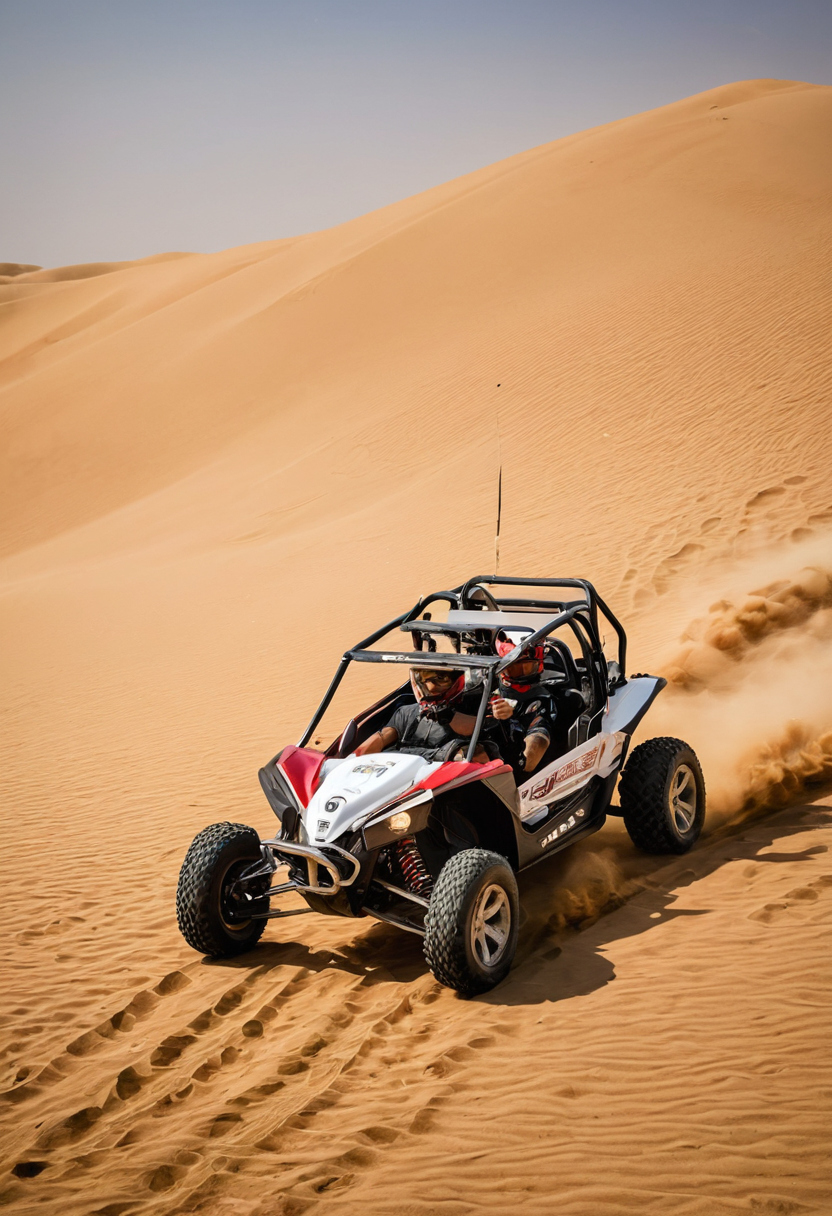
What should be confirmed before booking a Dubai buggy or quad bike shown as an editorial planning reference.
Before paying, request a matched vehicle, route, transfer and insurance specification. Book only the product described in that retained written record.
Frequently asked questions
How much does it cost to ride a dune buggy in Dubai?
There is no single reliable price for every dune buggy booking. Compare dated quotations using the same vehicle capacity, actual riding duration, transfer arrangement, taxes, mandatory fees and deposit conditions. Check whether the price applies per vehicle, seat, rider or group.
Which is better in Dubai, a dune buggy or a quad bike?
A buggy is usually the more practical match for couples, families or guests who want seated travel in one vehicle. A quad bike is the clearer match for an eligible solo rider who wants an individual machine. Supplier rules on capacity, control, supervision and insurance should decide the final choice.
Do you need a driving licence to drive a buggy in Dubai?
Do not assume one rule covers every buggy product. Ask the operator for a written answer tied to the named vehicle, operating area and participant category, then separate the applicable official requirement from any stricter supplier policy.
Are dune buggies safer than quad bikes or ATVs?
A vehicle category alone does not establish the safety of a particular booking. Compare the restraints, protective equipment, vehicle condition, route boundaries, guide format, briefing, participant eligibility and emergency procedure for the exact products offered.